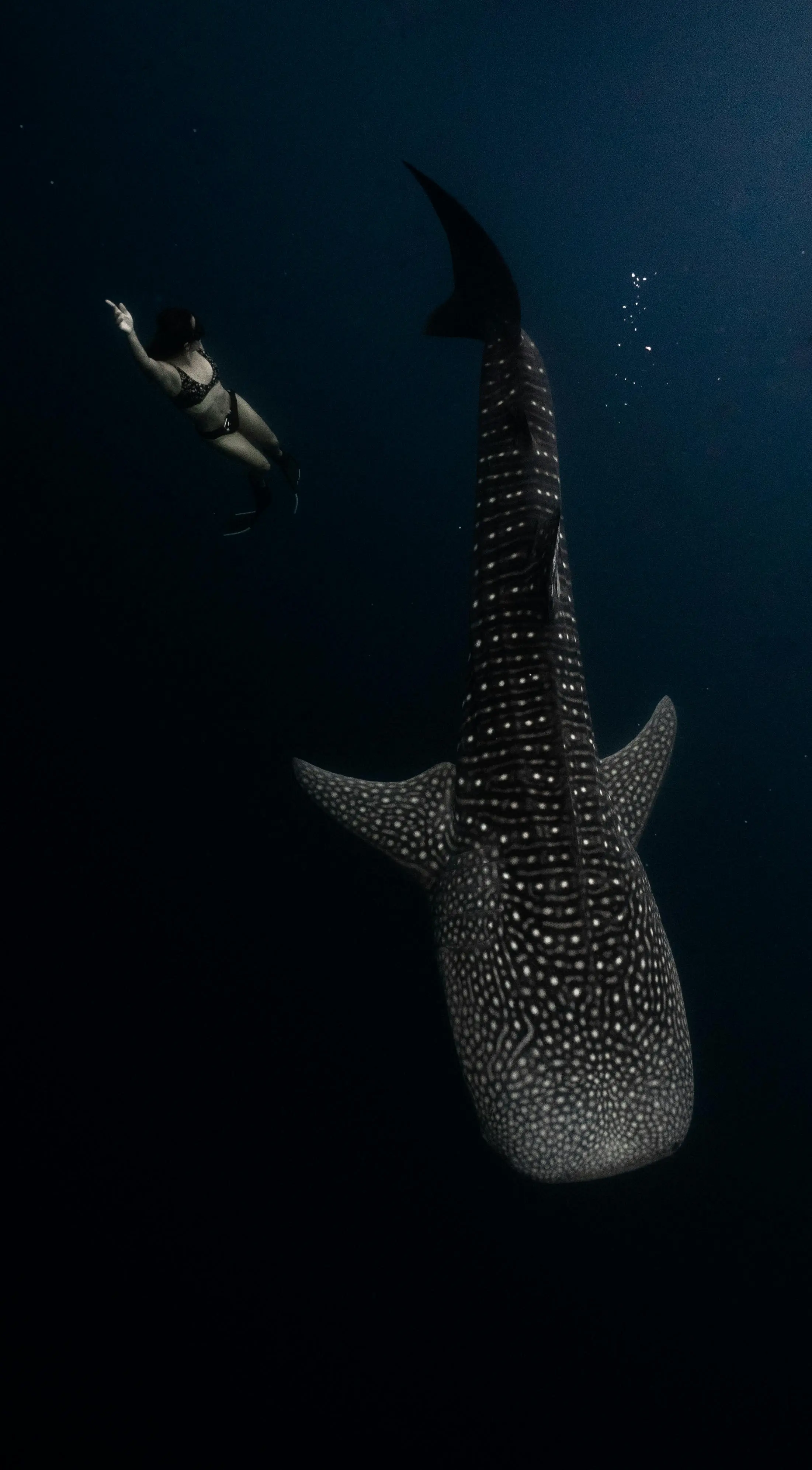
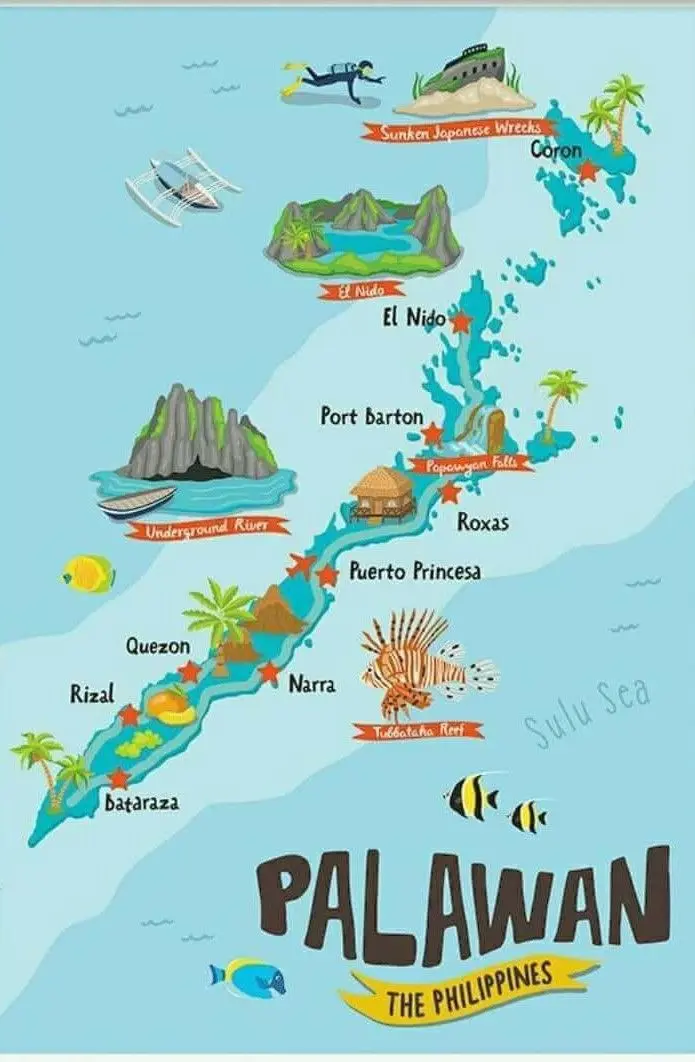
Dolphins are encountered year-round in the deeper water off Puerto Princesa, most often spinner dolphins and bottlenose dolphins. On our whale shark expedition they are frequently the first wildlife of the morning, met on the way out. We watch them from the boat, holding a parallel course and letting the pod decide whether to come closer — which, often enough, it does.
Which Species You Are Likely to See
Spinner dolphin (Stenella longirostris) — the one you will probably meet. Small, slender and genuinely acrobatic, named for the spinning leaps it makes while rotating around its own axis. Spinners are among the most commonly recorded dolphins in Philippine waters. They travel in groups that can number well into the hundreds.
Bottlenose dolphins (Tursiops species) — larger, heavier-bodied and more deliberate. Both the common bottlenose (T. truncatus) and the Indo-Pacific bottlenose (T. aduncus) occur in Philippine waters, and telling them apart at sea from a moving boat is harder than most tour descriptions admit.
Others that occur in the region — Risso’s dolphin (Grampus griseus) and Fraser’s dolphin are both recorded in Philippine waters. We see them rarely, and we log them when we do.
Palawan is one of the country’s main areas for cetaceans, which is a large part of why a morning here regularly produces more than one species.
A Word We Avoid: “Resident”
Plenty of Palawan tour pages describe “resident pods”. We do not, because residency is a specific scientific claim about site fidelity that requires photo-identification of individuals over years. That work has been done here for whale sharks. It has not, to our knowledge, been published for the dolphin groups we meet.
What we can say honestly: dolphins are encountered in these channels in every month we operate, and some individuals are recognisable by dorsal-fin marks. Whether the same animals stay year-round is a question our field notes cannot answer.
Why Spinner Dolphins Behave Differently in the Morning
Spinner dolphins feed at night on small fish and squid that rise from deep water after dark, then spend daylight hours resting and socialising in calmer, shallower water. That daily cycle explains most of what you see — and most of what responsible operators avoid.
A pod encountered mid-morning may well be resting. Boats that drive into the group to force a photo interrupt exactly the behaviour the animals came there for. It is the marine equivalent of waking someone repeatedly through the night: no single interruption looks harmful, and the cumulative effect is.
How We Approach a Pod
We hold a parallel course, matching the pod’s direction and speed at a steady distance, then let the dolphins close the gap if they want to. Philippine watching guidance says much the same: keep speed low near animals, approach from the side rather than head-on or from behind, and never cut across the group’s path.
This is also why our boat matters. Quiet four-stroke outboards put far less noise into the water than older diesel engines, and dolphins live by sound. The reward for patience is the thing people remember: animals arriving at the bow because they chose to, riding the pressure wave a metre or two from the hull, for as long as they find it interesting.
If a pod moves away, that is the end of the encounter. We do not turn and follow.
Why We Do Not Put People in the Water with Them
Swim-with-dolphins products exist across Southeast Asia and they sell well. We do not run one. Wild dolphins in the water with swimmers change behaviour immediately — resting groups disperse, mothers move calves away, feeding stops. The animals are also fast and powerful enough that the risk runs both ways.
Watching from the boat gets you closer to natural behaviour than swimming ever will, because the pod is doing what it would have done anyway.
The Law That Protects Them
Dolphins have been protected in Philippine waters since Fisheries Administrative Order 185 (1992), which banned taking, catching, selling, purchasing, possessing, transporting and exporting them. FAO 185-1 (1997) extended the ban to whales and porpoises. Republic Act 9147, the Wildlife Act, protects wildlife from harassment more broadly.
Protection on paper is not protection in the water, which is why how a boat behaves still matters more than what the permit says.
Palawan’s Other Dolphins, and Why They Are a Warning
Far north of here, in Malampaya Sound near Taytay, lives a population of Irrawaddy dolphins (Orcaella brevirostris) — stocky, blunt-headed animals that look almost nothing like a spinner. That population is listed as Critically Endangered. Line-transect surveys estimated 77 individuals in 2001; a more recent estimate put it at about 35. Bycatch in fishing gear is the main driver, and the Sound has carried protected status since 2000 without the decline stopping.
It is a two-hour drive plus a boat trip from the nearest whale shark, and it is not on any tour we run. We include it because it is the honest counterweight to a cheerful dolphin page: in the same province, a dolphin population is disappearing, and the difference between wildlife tourism that helps and tourism that does not is mostly a matter of whether anyone is counting.
Pairing Dolphins with Whale Sharks
Between April and October, dolphins and whale sharks share the same morning. The pods are usually met on the way out or during the search; the whale shark part is the uncertain half, which is why we publish the crew sighting log rather than a promise. Outside that season we do not run the boat.
Sources
- FAO 185 (1992) and FAO 185-1 (1997) — Bureau of Fisheries and Aquatic Resources
- Malampaya Sound Important Marine Mammal Area — Marine Mammal Protected Areas Task Force
- Status, ecology and conservation of Irrawaddy dolphins in Malampaya Sound — Journal of Cetacean Research and Management
See the whale shark and dolphin expedition → · Read the sighting log · What to do in Puerto Princesa